The Primary Purpose of Pool Waterproofing
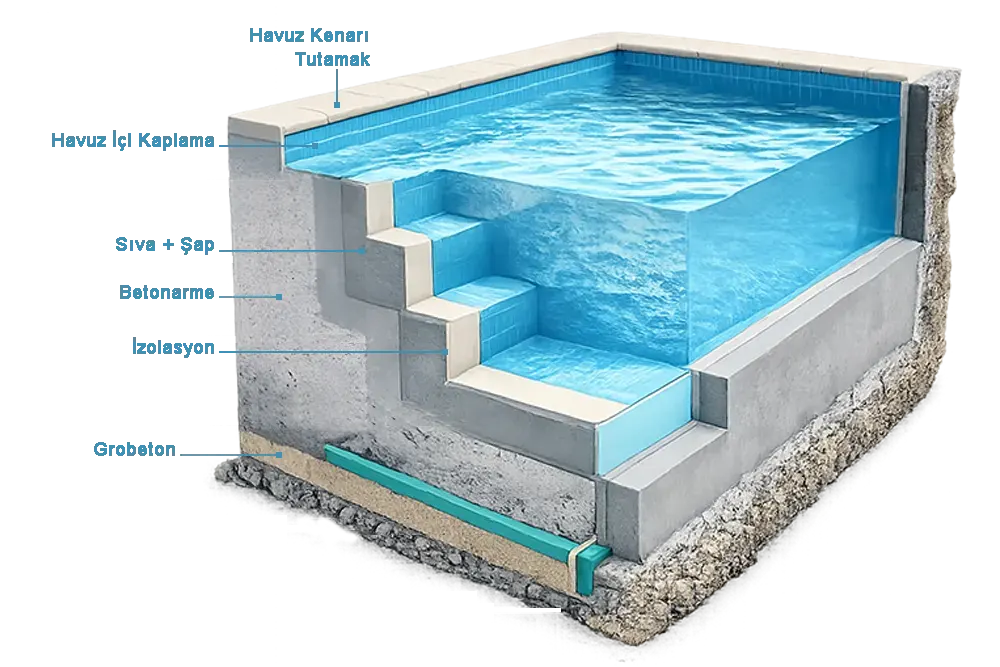
The greatest threat to a pool structure is water pressure.
Concrete that is constantly exposed to internal and external pressure develops microscopic cracks over time.
The purpose of waterproofing is to prevent these cracks from growing and turning into
water leaks.
- Prevents water loss.
- Extends the lifespan of the structure.
- Reduces chemical consumption.
- Lowers operating costs.
Properly applied pool waterproofing is a critical factor for both user safety
and the protection of your investment.
Problems That Occur When Water Tightness Is Not Ensured
When water tightness is not properly achieved in a swimming pool, issues that start
with minor leaks can quickly turn into serious problems.
Lack of waterproofing causes irreversible damage both structurally and aesthetically.
Below are the most common issues encountered:
-
Water leaks:
Continuous water loss leads to increased monthly bills and significant water waste.
In the long run, this multiplies operating costs and negatively affects sustainability.
-
Reinforced concrete damage:
When leaking water reaches the reinforcement steel, corrosion begins.
Rusting reinforcement results in concrete cracking and weakening of the load-bearing system,
seriously endangering the pool’s structural safety.
-
Surface covering deterioration:
Weak insulation causes tiles to bulge, grout joints to open,
and mosaics to detach from the surface.
This leads to aesthetic loss and costly re-tiling.
-
Chemical imbalance:
Due to continuous water loss, chlorine and pH levels cannot remain stable.
As chemical balance deteriorates, hygiene cannot be maintained,
algae growth accelerates, and water quality declines.
-
Aesthetic degradation:
Over time, discoloration, stains, mold layers, and algae formation appear on surfaces.
This negatively affects not only visual comfort but also user health.
As seen, lack of waterproofing threatens not only the pool’s ability to retain water
but also its long-term durability and safety.
Such problems significantly shorten the pool’s lifespan while dramatically increasing maintenance
and repair costs. Therefore, a proper waterproofing investment at the initial stage
provides substantial financial and operational benefits in the long term.
Types of Pool Waterproofing
Today, various techniques are used for pool waterproofing.
The selected method varies depending on factors such as the pool’s intended use,
structural characteristics, soil conditions, and budget.
Each method has its own advantages, limitations, and ideal applications:
-
Crystalline waterproofing:
Penetrates concrete pores through chemical reaction, forming crystals that block water penetration.
It provides internal protection and is highly durable and long-lasting.
One of the most preferred methods for reinforced concrete pools.
-
Liquid-applied membranes:
Polyurethane-, epoxy-, or acrylic-based materials applied by coating the surface.
Their flexible structure provides resistance to microcracks.
Widely used in modern pools due to ease of application and high waterproofing performance.
-
Bitumen-based materials:
Commonly used as an additional protective layer on the exterior surfaces of pools.
They offer an economical solution but have a shorter lifespan compared to other methods.
Typically preferred in cost-sensitive projects.
-
PVC / liner membranes:
Frequently used in prefabricated or factory-produced pool systems.
Installation is fast, and water tightness is achieved immediately.
Various color and pattern options provide aesthetic advantages.
-
Fiberglass coating:
Offers long-term use thanks to high chemical resistance.
Its smooth surface provides both an elegant appearance and easy cleaning.
A suitable solution for users who frequently manage chemical balance.
In conclusion, the choice of waterproofing method should be determined based on
the pool type, usage intensity, soil structure, climate conditions, and budget.
When the correct system is selected through professional inspection and engineering analysis,
the pool can be used safely and problem-free for many years.
The Importance of Professional Application for Long-Lasting Pools
Pool waterproofing depends not only on the right material selection
but also directly on application quality.
Unprofessional workmanship can render even the highest-quality materials ineffective
and cause serious water tightness problems over time.
Therefore, if a long-lasting pool is the goal, the experience of expert teams
and applications compliant with engineering standards are essential.
Key points to consider:
- The reinforced concrete surface must be smooth, clean, and ready for application.
- No cracks, segregation, or voids should remain on the surface; otherwise, the waterproofing layer weakens.
- Waterproofing layers must be applied uniformly and continuously.
- Specified curing and waiting times in technical datasheets must be strictly followed.
-
Subsequent stages such as tiling, mechanical installation, or electrical works
must be carried out carefully to avoid damaging the waterproofing layer.
All these steps ensure that the pool remains watertight, safe, and aesthetically pleasing for many years.
Therefore, when building a pool, attention should be paid not only to materials
but also to the professionalism of the application team.
Working with experienced specialists enhances waterproofing quality
and protects your investment in the long term.
The Relationship Between Energy Efficiency and Waterproofing
Properly applied pool waterproofing not only guarantees water tightness
but also provides significant advantages in terms of energy efficiency.
By minimizing water and heat losses, waterproofing reduces operating costs
and supports environmental sustainability.
- Stable water level: Eliminates the need for constant water refilling and prevents unnecessary consumption.
- Reduced chemical usage: Water balance is maintained, lowering chemical consumption by 20–30%.
- Minimized heat loss: Water temperature is preserved, significantly reducing heating costs.
As a result, pools with effective waterproofing achieve higher energy efficiency
and provide substantial cost savings in the long run,
while enabling environmentally responsible and sustainable pool use.
Tips for Long-Lasting Pools
For a pool to operate smoothly for years, not only waterproofing
but also regular maintenance processes are crucial.
Without proper maintenance, even the highest-quality waterproofing can lose effectiveness over time.
Here are practical tips to extend your pool’s lifespan:
- Regular visual inspections after waterproofing to check for bulging or discoloration.
- Grout joints should be renewed at least once a year; loosened joints must be refilled.
-
When the pool is drained, all surfaces should be thoroughly inspected
for cracks, bulging, or potential leaks.
-
Chemical balance (chlorine, pH) should be monitored regularly
to prevent sudden fluctuations.
-
Environmental factors (tree roots, groundwater, soil movement)
should be considered and preventive measures taken.
Following these steps supports waterproofing and helps achieve a
strongly watertight, long-lasting pool,
preserving the value of your investment for many years.
Frequently Asked Questions
How long does waterproofing last?
With proper material selection and professional application, it can be used safely for
15–20 years.
Regular maintenance can extend this period even further.
What is the best waterproofing method?
In reinforced concrete pools, the most commonly preferred methods are
crystalline waterproofing and liquid-applied membrane coatings.
These methods provide high durability, resist cracking, and offer cost-effective solutions in the long term.
How much does waterproofing cost?
The cost varies depending on the pool size, selected materials, and workmanship quality.
However, in the long run, waterproofing ensures return on investment by
preventing water loss and reducing chemical consumption.
Conclusion
The heart of a pool is waterproofing.
Pool waterproofing not only keeps the water inside; it extends the structure’s lifespan,
reduces operating costs, and provides users with a safe swimming experience.
With the right materials, professional application, and regular maintenance,
it is possible to achieve pools that are highly watertight, aesthetic, and long-lasting.
As Artemis Pool, with years of experience, we apply the most modern techniques in pool waterproofing
and offer our clients solutions that are both durable and visually appealing.