info@artemispool.com
+90 505 732 57 56
Olympic pool dimensions 50m length 25m width lane size and FINA standards

Olympic Pool Dimensions (FINA Standards Guide)

17 March 2026 25 min read

Olympic swimming pools are professional sports facilities designed according to specific technical criteria to host international competitions. The dimensions of these pools, including lane count, depth, and equipment placement, are not determined randomly. All measurements must comply with the regulations established by the international swimming federation.

Olympic pool dimensions are essential for the global standardization of swimming competitions. Key technical elements such as pool length, lane width, water depth, and equipment positioning are defined by strict rules. This ensures that competitions held in different countries take place under identical technical conditions.

Olympic swimming pools are not designed solely for professional athletes. They are also widely used in training centers, sports complexes, municipal facilities, and university campuses. Therefore, when planning Olympic pool projects, both competition standards and daily usage requirements must be carefully considered.

In modern swimming pool systems, not only dimensions but also water circulation, filtration capacity, and hydraulic infrastructure play a crucial role. A properly designed Olympic pool system ensures high water quality, reduces maintenance costs, and provides ideal swimming conditions for athletes.

The standards used in Olympic pool design have been developed through years of sports science and engineering research. These standards aim to minimize wave impact during competitions, protect athlete performance, and ensure the accurate operation of timing systems.

Especially for facilities hosting international competitions, Olympic pool dimensions must be implemented precisely. Otherwise, the pool will not be approved for official events. For this reason, accurate technical calculations are a critical part of pool design projects.

This guide covers Olympic pool dimensions, semi-Olympic pool sizes, lane widths, water depth criteria, and technical standards used in competition pools in detail. It also explains the key engineering considerations involved in Olympic swimming pool design and construction.

When planning a swimming pool project, not only the dimensions but also the intended use of the pool is important. Some pools are designed for training or educational purposes, while others are built for national and international competitions. Therefore, Olympic pool projects must consider both measurement standards and technical infrastructure.

In Olympic pool design, various components such as lane count, lane dividers, starting platforms, and timing systems must be positioned in accordance with international standards. These elements ensure that competitions are conducted in a safe, fair, and professional environment.

This article serves as a comprehensive resource for institutions, sports facility managers, architects, and engineers planning to build an Olympic swimming pool. It also aims to clearly explain Olympic pool dimensions and their importance to anyone interested in swimming.

If a sports facility, municipal swimming pool, or an Olympic-standard pool project is being planned, applying these dimensions correctly is essential. A properly designed Olympic pool enhances athlete performance and ensures long-term safe and efficient use.

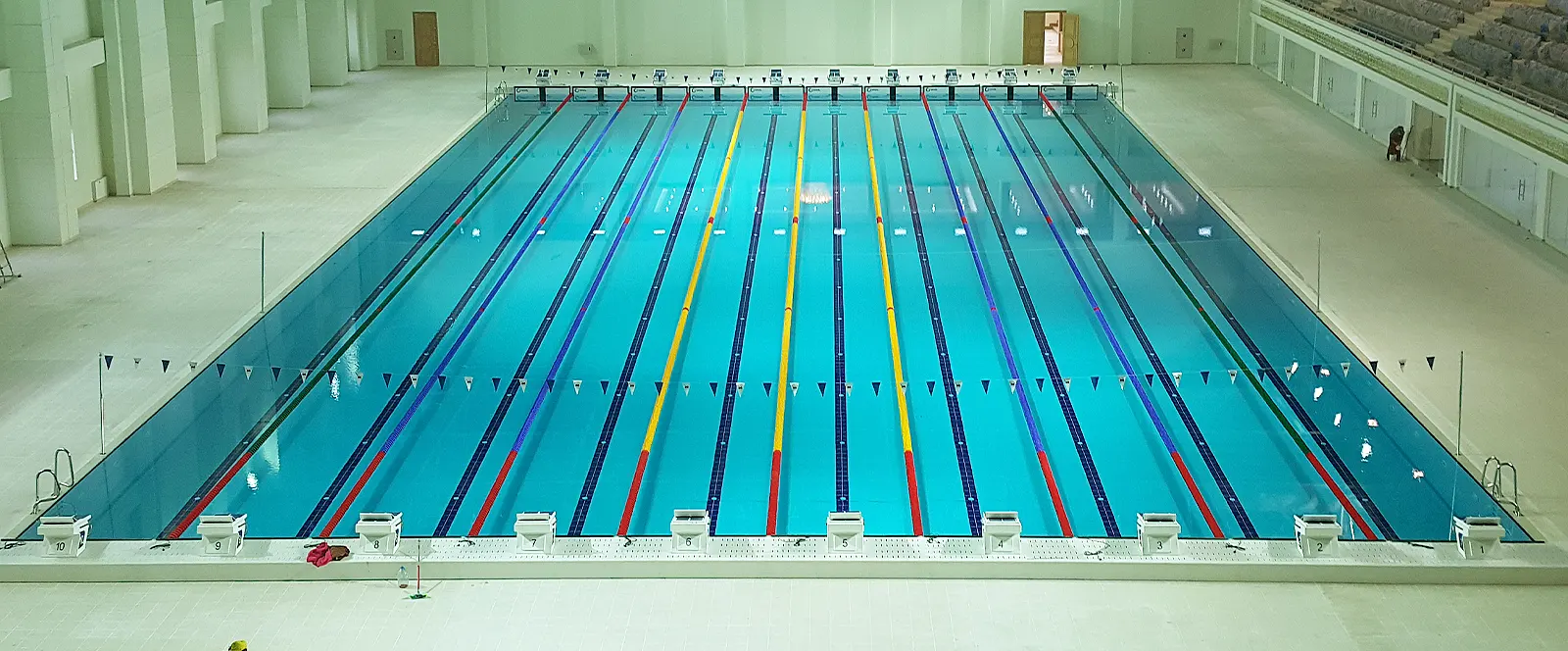
Olympic swimming pools must be designed in accordance with the standards set by World Aquatics (FINA) to host international competitions.
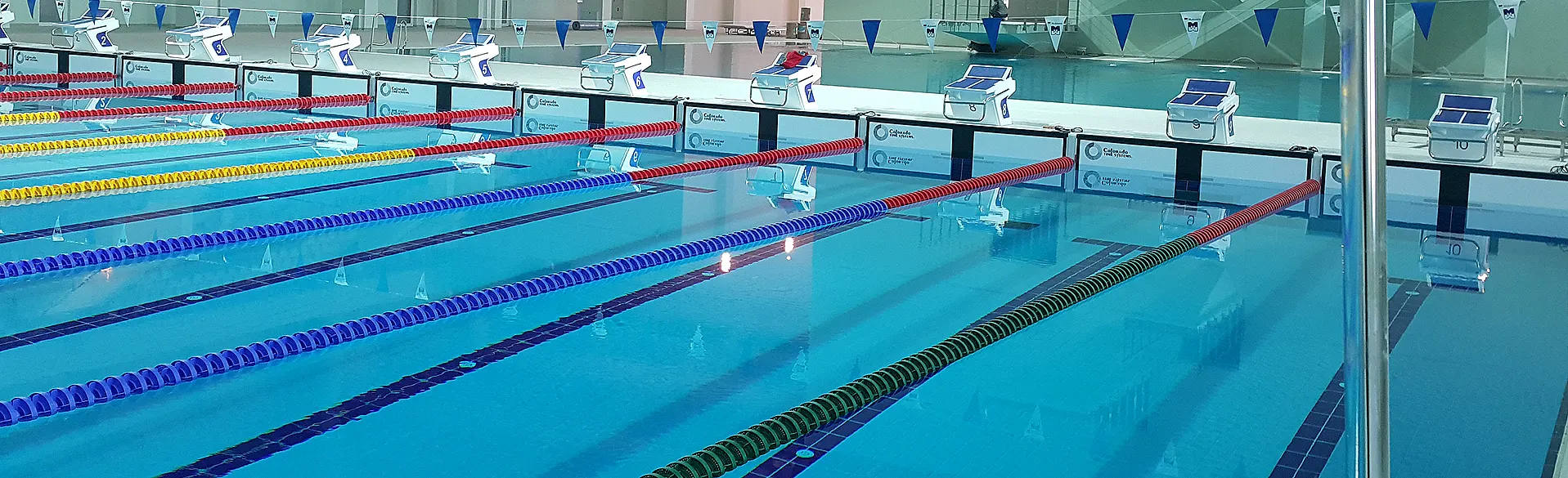
Pool Infrastructure Ready for International Competitions

Olympic pool dimensions are not limited to simply being “50 meters.” They must be evaluated together with technical requirements such as lane layout, balance tank capacity, filtration performance, water temperature, and flow rate. Proper design in accordance with standards ensures more stable water conditions, efficient maintenance processes, and consistently high user experience.

A properly designed filtration system is critical in Olympic pool projects. For more detailed information, you can review our pool filtration systems guide.

For more information about the technical standards of Olympic swimming pools, you can review the World Aquatics (FINA) regulations.

Download Catalogue (PDF)
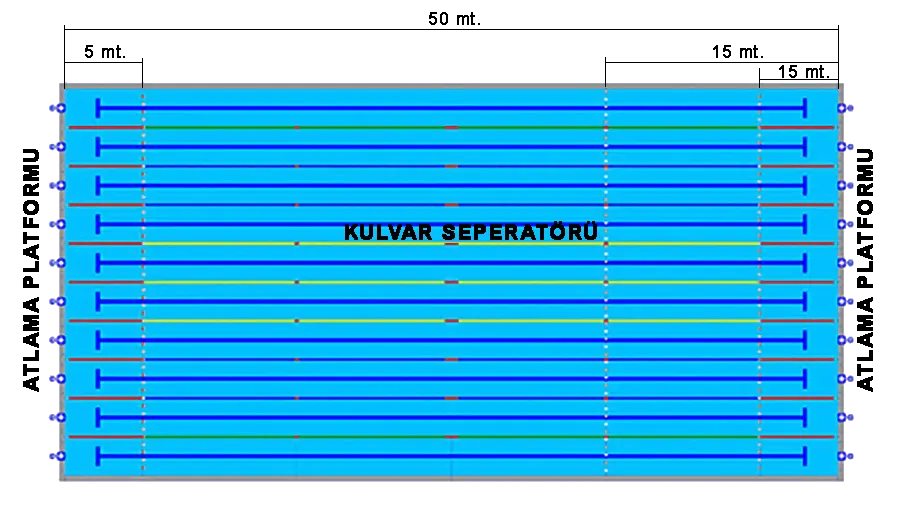
Olympic pool equipment layout plan according to FINA standards

What Is an Olympic Swimming Pool?

An Olympic swimming pool is a professional pool designed in accordance with specific standards to host national and international swimming competitions. These pools are not only used by professional athletes but also for swimming education, training sessions, and various sports organizations.

To host international competitions, the pool’s dimensions, number of lanes, water depth, and installed equipment must comply with strict standards. These standards have been established by international sports organizations that have guided the development of swimming for many years.

Olympic Pool Dimensions According to FINA Standards

The dimensions of Olympic swimming pools used in international competitions are defined by specific technical criteria. These measurements include not only the pool length but also the number of lanes, width, and depth.

Olympic pool dimensions are generally divided into two main categories:

  • Full Olympic swimming pool
  • Short course (semi-Olympic) swimming pool

Both types of pools can be used for competitions and training purposes, but their dimensions differ.

Full Olympic Pool Dimensions

Full Olympic swimming pools are standard pools used in international competitions such as the Olympic Games and World Championships.

Olympic pool length

The length of a full Olympic swimming pool is 50 meters. However, when considering the thickness of touchpad timing systems used in competitions, the total pool length is typically planned as 50.03 meters.

Olympic pool width

The width of an Olympic pool may vary depending on the number of lanes. The most common dimensions are:

  • 8-lane Olympic pool width: 25 meters
  • 10-lane Olympic pool width: 26 meters

In some competition pools, two additional lanes may be added to reduce wave impact. These lanes are not used for racing and serve as buffer zones.

Olympic pool depth

According to FINA standards, the minimum depth of Olympic swimming pools is 2 meters. However, in many modern competition pools, this depth can reach up to 3 meters to reduce wave effect and improve swimmer performance.

Semi-Olympic Pool Dimensions

Semi-Olympic swimming pools are generally used as training pools. They are commonly preferred in schools, sports complexes, and swimming clubs due to their smaller size.

Semi-Olympic Pool Length

The length of a semi-Olympic swimming pool is 25 meters. When competition timing systems are used, this measurement can be planned as approximately 25.03 meters to account for touchpad thickness.

Semi-Olympic Pool Width

The width of a semi-Olympic pool may vary depending on the number of lanes:

  • 5-lane semi-Olympic pool width: approximately 13.5 meters
  • 6-lane semi-Olympic pool width: approximately 16 meters

Semi-Olympic pools are ideal for swimming education, sports club training sessions, and small-scale competitions.

Olympic Pool Lane Dimensions

Lane width in Olympic swimming pools is defined by strict standards. Proper lane dimensions are essential to ensure fair competition conditions.

  • Lane width: 2.5 meters
  • Number of lanes: typically 8 or 10
  • Lane dividers: must have wave-dampening properties

Lane dividers prevent waves created by swimmers from affecting adjacent lanes. This ensures that all athletes compete under equal conditions during races.

Equipment Used in Olympic Swimming Pools

Olympic swimming pools are not just swimming areas. A wide range of technical equipment is required to conduct professional competitions.

Main Olympic Pool Equipment

  • Starting blocks
  • Lane dividers
  • Turn panels
  • Touchpad timing system
  • Officials’ chairs
  • Backstroke start indicators

All of this equipment must be positioned in accordance with international competition standards.

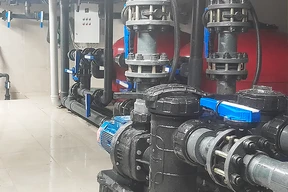
Hydraulic System in Olympic Pool Design

The performance of an Olympic pool depends not only on its dimensions but also on its hydraulic design. A well-designed hydraulic system plays a crucial role in maintaining water quality and ensuring an optimal user experience.

With a properly engineered hydraulic system, water circulates evenly throughout the pool and reaches the filtration system efficiently. This ensures consistently clean and balanced water conditions.

Key Factors in Hydraulic Design

  • Water circulation flow rate
  • Pipe diameters
  • Balance tank capacity
  • Filtration capacity
  • Nozzle placement

An improperly designed hydraulic system can create dead zones within the pool and lead to a decline in water quality.

Olympic Pool Filtration System

A powerful filtration system is essential to keep the water in Olympic pools continuously clean. In large-volume pools, filtration capacity must be accurately calculated.

A typical filtration system consists of the following components:

  • Sand filters
  • Circulation pumps
  • Balance tank
  • Automatic chlorination systems
  • pH control systems

A properly designed filtration system ensures crystal-clear water and reduces long-term maintenance costs.

Olympic Pool Design Process

A professional Olympic pool project goes beyond architectural design. Engineering calculations play a critical role in the design process.

Stages of Olympic Pool Design

  • Needs analysis
  • Architectural design
  • Hydraulic calculations
  • Filtration system planning
  • Equipment layout
  • Installation and construction

A properly designed Olympic pool can be used safely and efficiently for many years.

Importance of Olympic Pool Dimensions

Olympic pool dimensions are not only important for competition standards but also for swimmer performance. A pool designed with correct dimensions reduces wave effect and helps athletes achieve better performance.

Therefore, sports facilities aiming to host international competitions must be designed in full compliance with Olympic pool standards.

Conclusion

Olympic swimming pools are professional sports facilities designed according to strict technical standards. Pool length, width, number of lanes, depth, and all installed equipment must comply with international regulations.

A properly designed Olympic pool provides an ideal environment not only for competitions but also for training, education programs, and sports events. For this reason, accurate engineering calculations and full compliance with technical standards are essential in Olympic pool projects.

Our Reference Videos

Short highlights from our real projects.

Free price quote for pool projects - Artemis Pool

E-Catalog

As Artemis Pool & Fountain Systems, you can access detailed information about our products, applications, and fields of activity through our E-Catalog. Our engineering-focused solutions and professional services in compliance with international standards are summarized in this catalog.

Download the Catalog (PDF)