What Is a Balance Tank? Calculation, Design, Selection and Professional Application Guide
23 March 2026
26 min read
Share
A balance tank is one of the most critical engineering components used in overflow swimming pools to maintain a constant water level, recover overflow water and ensure uninterrupted system operation. Especially for
Olympic swimming pools and
swimming pools with high user density, a properly designed balance tank system plays a key role in both hygiene and performance.
This guide has been prepared as one of the most comprehensive technical resources on balance tanks.
What Is a Balance Tank? The Critical System That Stabilizes Water Level in Pools
A Pool System Cannot Operate Without a Balance Tank
A balance tank is a fundamental engineering component in overflow swimming pools that maintains a constant water level, recovers overflow water and ensures uninterrupted operation of the filtration system. Especially in high-usage Olympic and commercial pools, it balances water fluctuations and directly impacts both hygiene and system performance. A properly designed balance tank prevents water loss, protects pump systems and ensures stable pool operation under all conditions.
Definition of a Balance Tank
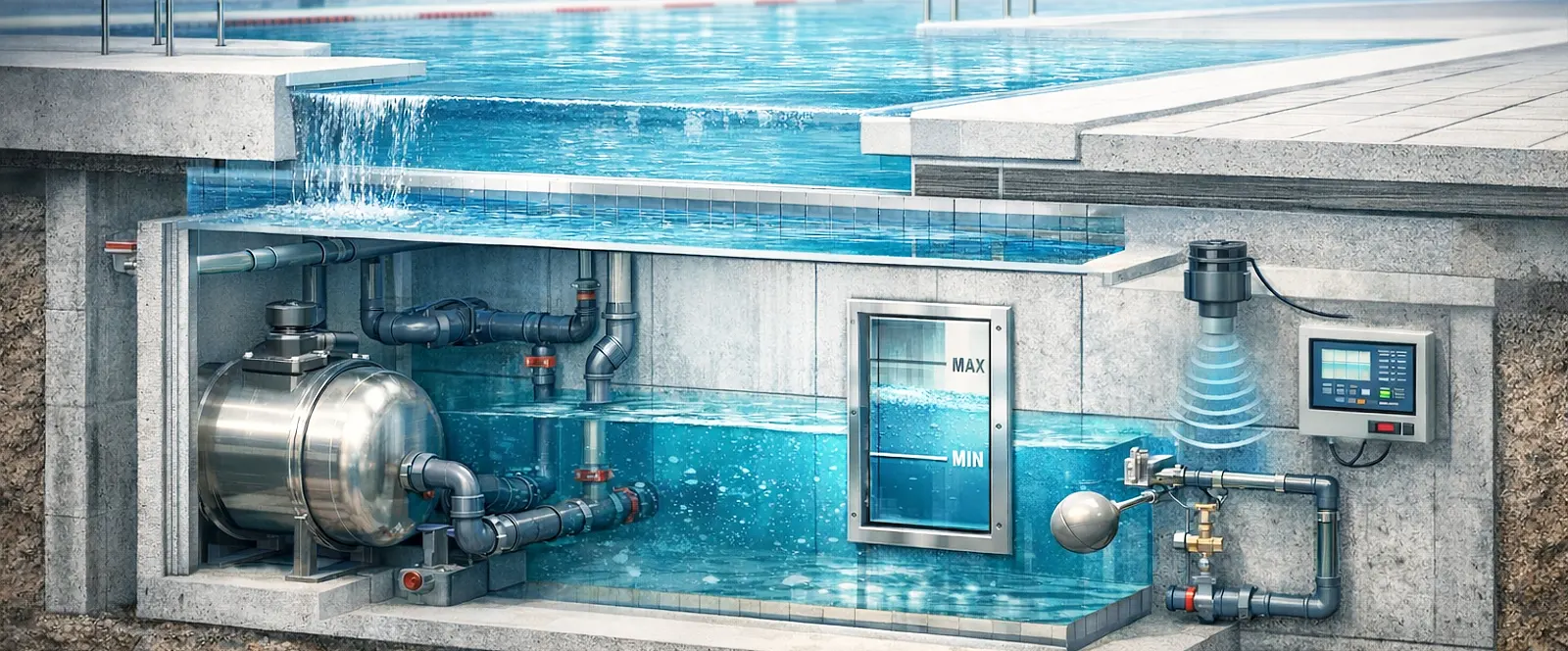
A balance tank is a reservoir system where water collected from overflow channels is stored and then returned to the filtration system in a controlled manner.
What Should Be Considered When Selecting a Balance Tank?
When selecting a balance tank, factors such as pool volume, user load, filtration flow rate and project type must be taken into account. Incorrect capacity selection can lead to system instability and serious performance losses.
Why Is a Balance Tank Necessary?
In overflow pools, when users enter the pool, the water level rises and flows out through overflow channels. When users leave, the water level drops. If this fluctuation is not controlled:
Pumps may draw air
Filtration system may fail
Water level becomes unstable
Hygiene decreases
A balance tank absorbs these fluctuations and stabilizes the system.
How Does a Balance Tank Work?
Overflow water enters the overflow channels
Water is collected in the balance tank
Pumps draw the water
It is sent to the filtration system
Cleaned water is returned to the pool
How Is Balance Tank Volume Calculated?
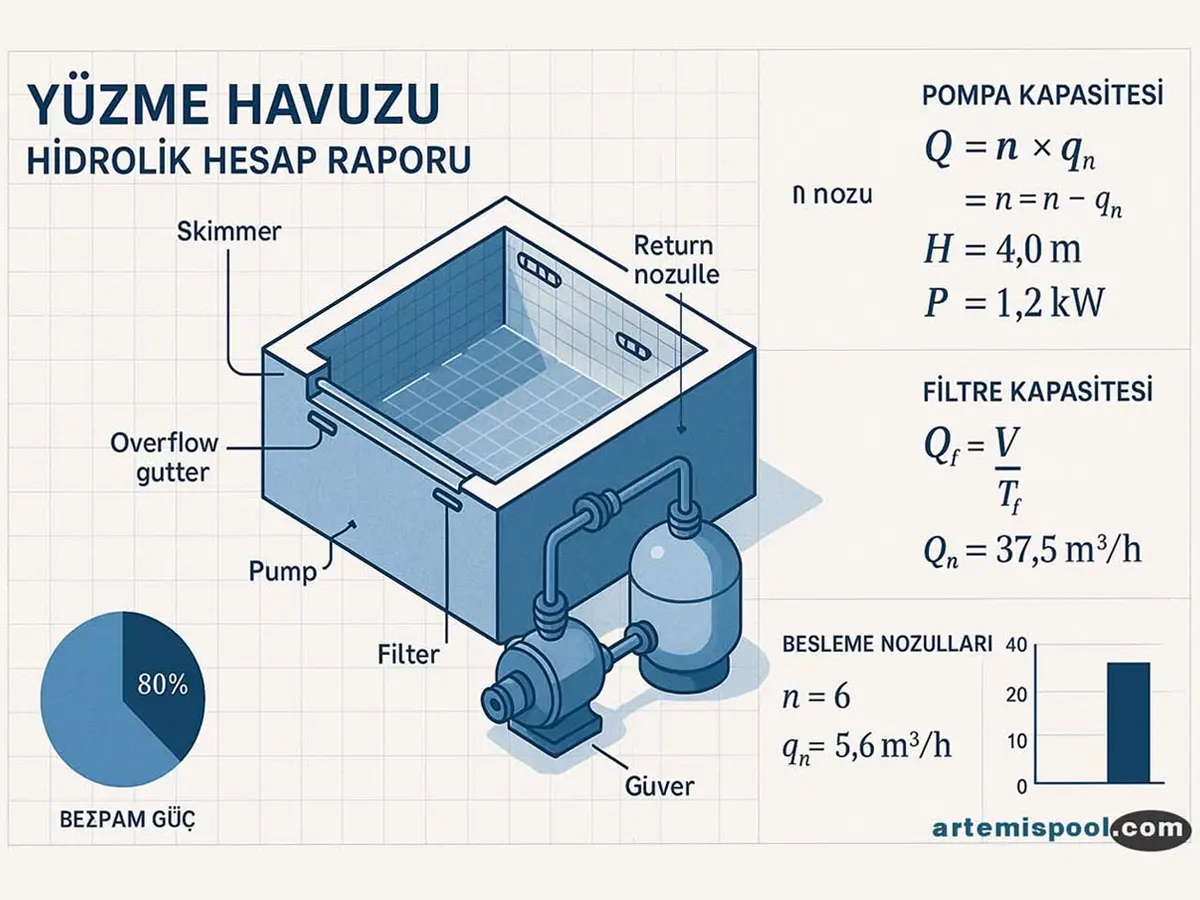
1. Basic Formula
The following components are considered when calculating balance tank volume:
Level switches are practical devices that provide on/off control at predefined minimum and maximum water levels in the balance tank. When the water reaches critical levels, they activate pumps or valve systems to ensure safe operation. They offer an economical and effective solution, especially in simple automation systems.
Balance tank level monitoring systems are critical for the proper operation of a balance tank. By combining manual and automated solutions, both safety and system continuity can be maximized.
Water Supply Systems
Float System
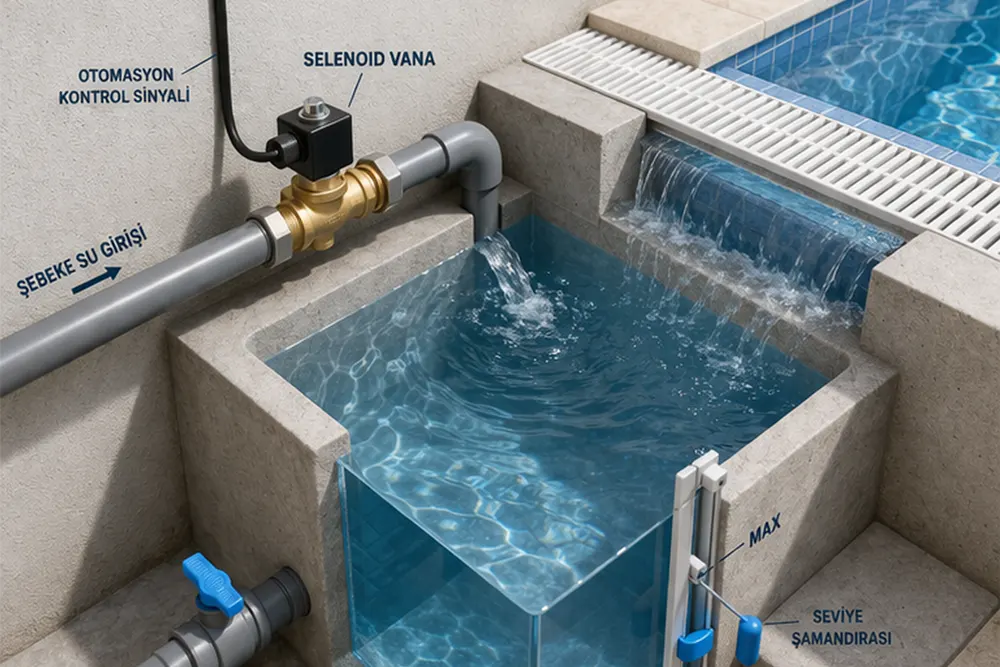
The float system is a practical and economical solution that provides water supply to the balance tank mechanically. When the water level drops, the float opens the valve mechanism and automatically feeds water into the tank; once the desired level is reached, the system shuts off. Since it does not require electricity and has a low risk of failure, it is widely used in standard swimming pool systems.
Solenoid Valve System
The solenoid valve system is a professional solution that controls water supply to the balance tank through automation. Water level is continuously monitored by sensors, and when it drops below the minimum level, the valve automatically opens to supply water into the tank. When the maximum level is reached, the system shuts off. Due to its precise control, water-saving capability and elimination of human error, it is widely preferred in Olympic and commercial pool projects.
Critical Rules in Balance Tank Design
Pumps should suction from the bottom
Bottom drainage must be included
Overflow line should be positioned at the top
Maintenance access should be easy
Ventilation must not be neglected
Common Mistakes
Incorrect or insufficient volume selection
Wrong pump suction point
Lack of level control system
Ignoring maintenance access
Professional Balance Tank Positioning
The balance tank should generally be positioned close to the machine room. This reduces piping losses and increases system efficiency.
Maintenance and Cleaning
Cleaning 2–3 times per year
Biofilm control
Use of bottom drainage
Sensor calibration
Conclusion
A balance tank is one of the most critical engineering components that ensures overflow swimming pools operate safely, efficiently and hygienically. By stabilizing water level fluctuations, it supports uninterrupted filtration and enables significant water savings by recovering overflow water. Especially in Olympic, commercial and high-usage pools, a properly designed balance tank system is essential for maintaining hygiene standards and ensuring long-term system performance.
Selecting the correct volume, using appropriate materials and supporting the system with level control technologies improve pump efficiency, optimize energy consumption and reduce operational costs. Additionally, balance tanks integrated with automation systems ensure continuous water level control, minimize human intervention and enhance overall system safety.
In conclusion, in a professional pool project, a balance tank is not just an auxiliary component but a core element of the entire system. A properly engineered balance tank plays a vital role in creating a long-lasting, sustainable and high-performance pool system.
Frequently Asked Questions
Is a balance tank mandatory?
Yes, it is mandatory in overflow swimming pool systems.
What should the balance tank volume be?
It is generally selected as 5–10% of the pool volume.
Which is the best type of balance tank?
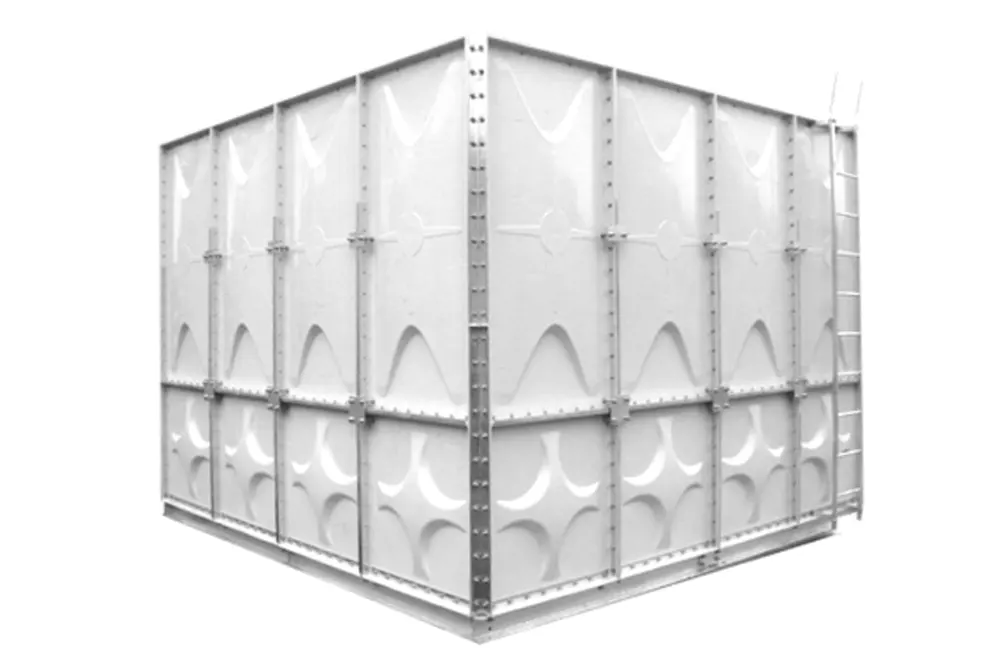
It depends on the project. Reinforced concrete is recommended for large-scale projects.
How is balance tank volume calculated?
Balance tank volume is calculated based on pool surface area, user load, overflow amount and filtration flow rate. Although 5–10% of the pool volume is commonly used as a reference, higher capacities may be preferred in professional projects depending on user density.
Where should a balance tank be located?
The balance tank is typically positioned close to the machine room and below ground level. This ensures natural water flow, improves pump efficiency and minimizes system losses.
How is water level controlled in a balance tank?
Water level can be controlled manually using sight glasses and float systems, or automatically using ultrasonic sensors, level switches and solenoid valves. Automated systems provide more precise and reliable control.
Can a pool operate without a balance tank?
In overflow pool systems, it is not possible to operate efficiently without a balance tank. Water levels cannot be stabilized, filtration becomes inconsistent and hygiene is significantly reduced.
Our Blog Posts
Up-to-date blog articles about our areas of expertise and application solutions.
As Artemis Pool & Fountain Systems, you can access detailed information about our products, applications, and fields of activity through our E-Catalog. Our engineering-focused solutions and professional services in compliance with international standards are summarized in this catalog.